







weekend gap statistics and distribution analyzer
Info
The weekend gap statistics and distribution analyzer is a Indicator for MetaTrader 5 that weekend gap statistics and distribution analyzera common adage in trading is that "all weekend gaps close. " however, trading this anomaly without understanding the underlying statistics can lead to significant drawdowns.
Usage
This tool is typically used for enhancing chart analysis and decision making.
Platform
This Indicator works exclusively on MetaTrader 5 (both build 600+ and newer versions).
Setup
Place the downloaded file in MQL5/Indicators folder via File ? Open Data Folder in MetaTrader 5.
How to Install and Use weekend gap statistics and distribution analyzer
1. Installation: Place your file in the MQL/Indicators folder via "Open Data Folder" and restart your terminal.
2. Loading: Find the indicator in the Navigator, drag it onto your chart, and configure the input parameters in the popup window.
3. Customization: Press Ctrl+I to open the indicator list, select your tool, and click "Properties" to change colors, levels, or visual styles.
4. Updating: Replace the old file in the Indicators folder with the new version and restart the platform to apply changes.
Frequently Asked Questions
Q: Why is my indicator not showing? A: Verify the file is in the MQL/Indicators folder, or try right-clicking the "Indicators" tree in the Navigator and clicking "Refresh."
Q: Do custom indicators slow down the platform? A: Too many complex indicators can impact performance; remove unused ones via the "Indicator List" (Ctrl+I).
Q: Can I use MT4 indicators on MT5? A: No, MQL4 and MQL5 are distinct languages; ensure the indicator is compiled specifically for your platform version.
What this tool does
weekend gap statistics and distribution analyzera common adage in trading is that "all weekend gaps close.
Typical Use Case
This Indicator excels in automated trading and technical analysis on MetaTrader 5.
Compatible Platform & Setup
This Indicator works on MetaTrader 5. Place the file in the MQL5/Indicators folder and restart the terminal.
Description & Settings
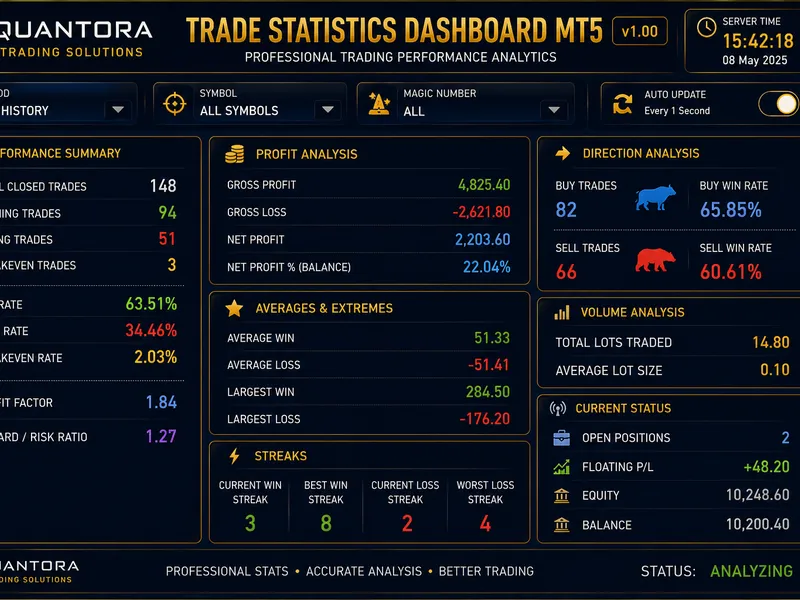
Related: Quantora Trade Statistics Dashboard MT5 - Professional Trading Performance Analytics - another powerful indicator for MetaTrader 5 traders.
weekend gap statistics and distribution analyzerAlso recommended: MT5 Trade Report Table: Comprehensive Account Statistics - similar indicator with strong performance on MetaTrader 5.
a common adage in trading is that "all weekend gaps close." however, trading this anomaly without understanding the underlying statistics can lead to significant drawdowns. the weekend gap statistics & distribution analyzer quantifies this behavior for any specific instrument and timeframe. it calculates exactly how often gaps close, how much profit you can reasonably expect, and critically, how much heat a trader must endure before the closure occurs.
all metrics are displayed in a non-intrusive dashboard anchored to the lower-left corner of the chart. the display features dynamic contrast, automatically switching between light and dark text to ensure readability against any chart background.
key features
multi-timeframe analysis:
breaks down statistics into three distinct periods: the last 5 gaps, the last 12 months, and all available history.
reward vs. risk tracking:
simultaneously tracks maximum favorable excursion (mfe) and maximum adverse excursion (mae) to give a complete picture of trade viability.
take profit predictor:
calculates the exact points reached by historical gaps to establish highly probable take profit targets.
stop loss optimizer:
calculates the historical drawdown of closed gaps to help you set mathematical stop losses that survive market noise.
smart ui:
uses a small, clean monospace font anchored to the lower-left corner, leaving your chart free for your actual trading analysis.
understanding the dashboard metrics
the indicator categorizes historical data and displays the following data points for each period:
total & closed gaps:
the absolute number of weekend gaps identified, alongside the count and percentage of gaps that successfully closed.
avg size | avg mfe | avg mae:
the baseline averages. it shows the average opening gap size, the average maximum favorable excursion (reward), and the average maximum adverse excursion (risk/heat).
tp hit rate (mfe >=):
this metric analyzes all historical gaps and calculates the exact points reached by 95%, 70%, 50%, and 25% of them. if the 70% metric reads "85 pts," it means that 70% of the time, fading the gap yielded at least 85 points of profit.
sl survival (mae <=):
this metric analyzes only the gaps that successfully closed and tells you the maximum heat taken. if the 95% metric reads "200 pts," it means that 95% of gaps that successfully closed did so while taking 200 points of heat or less.
input parameters
min gap size (in points):
the minimum required distance between friday's close and monday's open to register as a valid gap. this filters out negligible price differences. you must adjust this based on the asset class and the decimal precision of your broker (e.g., a 10-pip gap on a 5-digit broker is 100 points).
max history bars to scan:
limits the historical lookback period to preserve terminal memory and computational resources. the default is 100,000 bars.
practical usage guide
1. data-driven take profit targets
instead of blindly targeting the exact friday close, you can now use the tp hit rate tiers. if an asset has a 95% hit rate of achieving 40 points in favorable excursion, you can confidently set a partial or full take profit at 40 points. you will know you have overwhelmingly high historical odds of the price reaching that level, even if the gap ultimately fails to close completely.
2. optimizing stop loss placement
by utilizing the sl survival distributions, traders can place highly accurate stop losses. standard averages can be heavily skewed by single, massive historical outliers. if you are fading a gap and your stop loss is placed well within the 95th percentile of historical adverse heat, you are statistically protecting your trade from premature stop-outs. place stops just outside these percentile boundaries to give the trade adequate room to breathe without exposing your account to catastrophic outlier risk.
You may also like: Trade Statistics Display - excellent alternative for indicator users on MetaTrader 5.
Source Code
#property copyright "robotfx"
#property link "https://robotfx.org"
#property version   "1.40"
#property indicator_chart_window
#property indicator_plots 0
input int    inpmingappoints = 20;
input int    inpmaxbarsscan  = 100000;
struct gapdata {
datetime time;
double   gappoints;
.......
⚠ Limitations & Risk Warning
- This tool is provided for educational and testing purposes only.
- Past performance does not guarantee future results.
- Trading involves substantial risk of loss. Use on a demo account first.
- Results may vary depending on market conditions, broker, and settings.
- We recommend thorough backtesting and forward testing before using with real funds.