AD X Indicator (MQ L5)
This professional-grade solution for MetaTrader 5 helps traders achieve greater efficiency in their daily workflow. This technical indicator acts as a specialized analysis tool designed to visualize market data. It helps traders identify emerging trends, momentum shifts, and key support or resistance levels by plotting statistical calculations directly onto price charts.
How to Setup and Use AD X Indicator (MQ L5)
1. Installation: Place your file in the MQL/Indicators folder via "Open Data Folder" and restart your terminal.
2. Loading: Find the indicator in the Navigator, drag it onto your chart, and configure the input parameters in the popup window.
3. Customization: Press Ctrl+I to open the indicator list, select your tool, and click "Properties" to change colors, levels, or visual styles.
4. Updating: Replace the old file in the Indicators folder with the new version and restart the platform to apply changes.
Frequently Asked Questions
Q: Why is my indicator not showing? A: Verify the file is in the MQL/Indicators folder, or try right-clicking the "Indicators" tree in the Navigator and clicking "Refresh."
Q: Do custom indicators slow down the platform? A: Too many complex indicators can impact performance; remove unused ones via the "Indicator List" (Ctrl+I).
Q: Can I use MT4 indicators on MT5? A: No, MQL4 and MQL5 are distinct languages; ensure the indicator is compiled specifically for your platform version.
Description & Settings
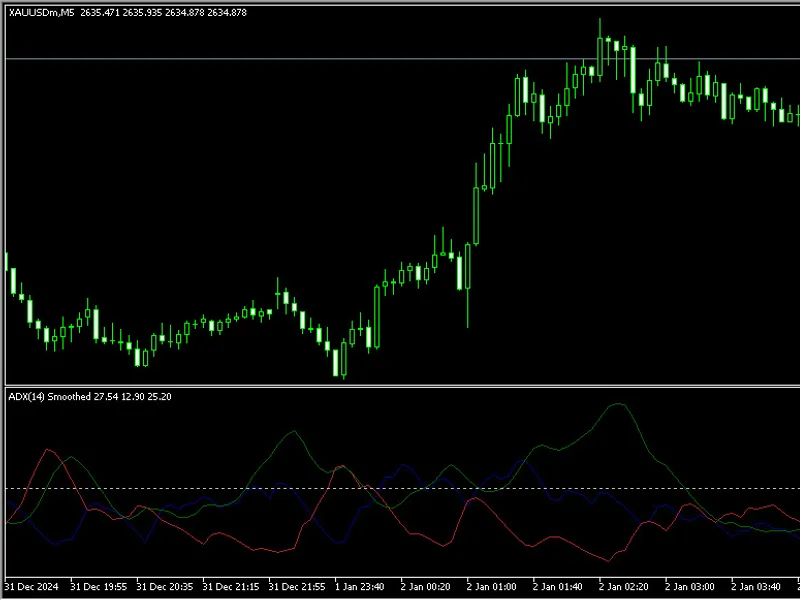
This ADX Smoothed indicator offers significant improvements over traditional implementations. Key enhancements include:
Robust Error Prevention with comprehensive bounds checking to eliminate array out-of-range errors
Optimized Performance using efficient buffer management and data acquisition techniques
Reliable Calculation Logic with fail-safe indexing and proper initialization
Resource-Efficient Design featuring proper handle management and memory allocation
Modern MQL5 Structure utilizing dedicated indicator properties and typed buffer assignments
These improvements result in a more stable, efficient, and maintainable indicator that meets professional trading standards while retaining the core ADX smoothing algorithm's analytical value.