








ra v i (range action verification index)
Info
The ra v i (range action verification index) is a Indicator for MetaTrader 5 that unknownthe indicator represents the relative convergence/divergence of the moving averages of the financial asset, increased a hundred times. it is based on a different principle than the adx.
Usage
This tool is typically used for enhancing chart analysis and decision making.
Platform
This Indicator works exclusively on MetaTrader 5 (both build 600+ and newer versions).
Setup
Place the downloaded file in MQL5/Indicators folder via File ? Open Data Folder in MetaTrader 5.
How to Install and Use ra v i (range action verification index)
1. Installation: Place your file in the MQL/Indicators folder via "Open Data Folder" and restart your terminal.
2. Loading: Find the indicator in the Navigator, drag it onto your chart, and configure the input parameters in the popup window.
3. Customization: Press Ctrl+I to open the indicator list, select your tool, and click "Properties" to change colors, levels, or visual styles.
4. Updating: Replace the old file in the Indicators folder with the new version and restart the platform to apply changes.
Frequently Asked Questions
Q: Why is my indicator not showing? A: Verify the file is in the MQL/Indicators folder, or try right-clicking the "Indicators" tree in the Navigator and clicking "Refresh."
Q: Do custom indicators slow down the platform? A: Too many complex indicators can impact performance; remove unused ones via the "Indicator List" (Ctrl+I).
Q: Can I use MT4 indicators on MT5? A: No, MQL4 and MQL5 are distinct languages; ensure the indicator is compiled specifically for your platform version.
What this tool does
unknownthe indicator represents the relative convergence/divergence of the moving averages of the financial asset, increased a hundred times.
Typical Use Case
This Indicator excels in automated trading and technical analysis on MetaTrader 5.
Compatible Platform & Setup
This Indicator works on MetaTrader 5. Place the file in the MQL5/Indicators folder and restart the terminal.
Description & Settings
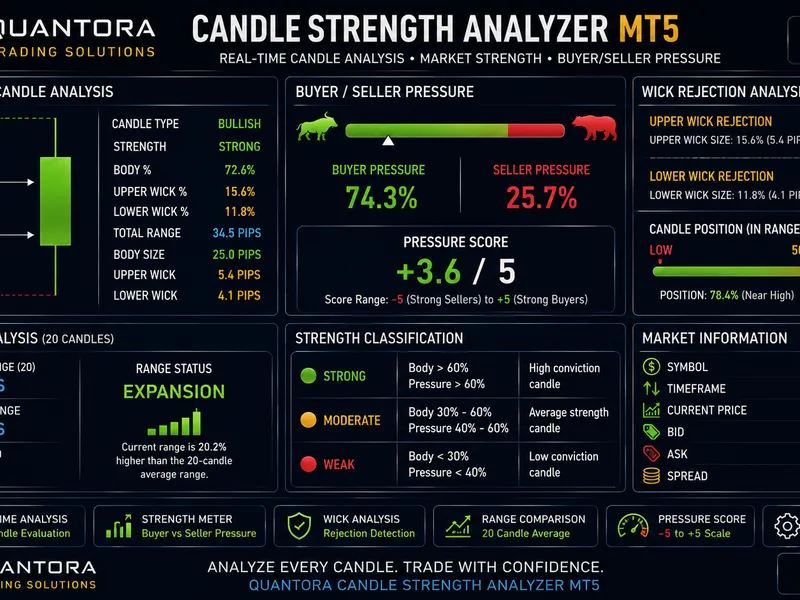
Related: Quantora Candle Strength Analyzer MT5: Price Action and Wick Analysis - another powerful indicator for MetaTrader 5 traders.
Also recommended: fixed-width fractional differencing (ffd) - similar indicator with strong performance on MetaTrader 5.
unknownthe indicator represents the relative convergence/divergence of the moving averages of the financial asset, increased a hundred times. it is based on a different principle than the adx. chande suggests a 13-week sma as the basis for the indicator. it represents the quarterly (3 months = 65 working days) sentiments of the market participants concerning prices. the short moving average comprises 10% of the one and is rounded to seven.
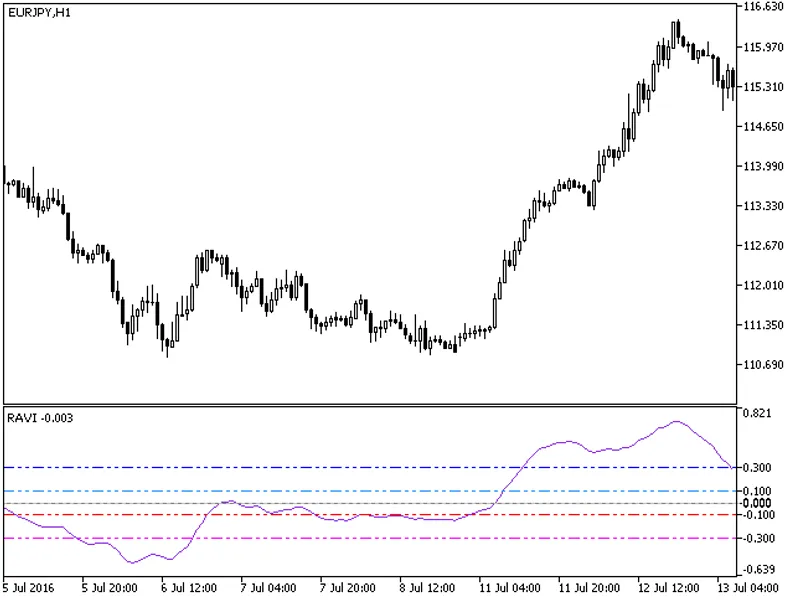
tushar chande suggests the following reference lines for the ravi indicator: plus-minus 0.3% or plus-minus 0.1% (depending on the market). when the indicator crosses the upper reference line upward, an uptrend is considered to have started. when the indicator crosses the lower reference line downward, a downtrend is considered to have started. the uptrend is considered to be continuing while the ravi line grows. the downtrend, respectively, while the ravi falls. as soon as the indicator reverts to the zero line, the trend is considered to have ended, and a channel is considered to have started. but if the indicator reverses again, without entering the gap between the reference lines, the trend is considered to have resumed.
essentially, the proposed indicator is quite simple and almost identical to the price oscillator and macd. the uniqueness is in the use of the price convergence-divergence value as the trend indication, paying attention to the divergence and not the crossing of the averages.
after examining the plotting method of the АdХ, it can be said that the indicator has two smoothings. ravi has one smoothing. this makes the indicator more sensitive. with the specified values, it warns about the beginning and end of a trend earlier than an 18-day adx.
the indicator uses smoothalgorithms.mqh library classes (copy it to <terminal_data_folder>\mql5\include). the use of the classes was thoroughly described in the article .
originally this indicator has been written in mql4 and was first published in the on 15.02.2008.
fig.1. the ravi indicator
You may also like: rsi price action breakout indicator - excellent alternative for indicator users on MetaTrader 5.
Source Code
#property copyright "robotfx"
#property link "https://robotfx.org"
#property description "this code is educational. feel free to use, modify and upgrade as you wish. visit robotfx.org for professional trading tools"
#property version   "1.00"
#property indicator_separate_window
#property indicator_buffers 1
#property indicator_plots   1
#property indicator_level1  0
#property indicator_levelcolor clrblueviolet
#property indicator_levelstyle style_solid
.......
⚠ Limitations & Risk Warning
- This tool is provided for educational and testing purposes only.
- Past performance does not guarantee future results.
- Trading involves substantial risk of loss. Use on a demo account first.
- Results may vary depending on market conditions, broker, and settings.
- We recommend thorough backtesting and forward testing before using with real funds.