






hurst exponent
Info
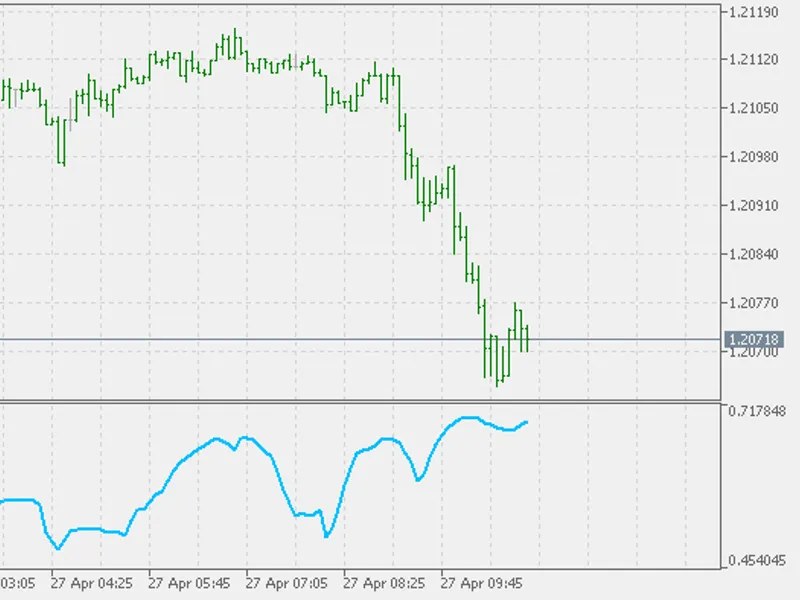
The hurst exponent is a Indicator for MetaTrader 5 that the hurst exponentis used as a measure of long-term memory of time series. it relates to the autocorrelations of the time series, and the rate at which these decrease as the lag between pairs of values increases.
Usage
This tool is typically used for enhancing chart analysis and decision making.
Platform
This Indicator works exclusively on MetaTrader 5 (both build 600+ and newer versions).
Setup
Place the downloaded file in MQL5/Indicators folder via File ? Open Data Folder in MetaTrader 5.
How to Install and Use hurst exponent
1. Installation: Place your file in the MQL/Indicators folder via "Open Data Folder" and restart your terminal.
2. Loading: Find the indicator in the Navigator, drag it onto your chart, and configure the input parameters in the popup window.
3. Customization: Press Ctrl+I to open the indicator list, select your tool, and click "Properties" to change colors, levels, or visual styles.
4. Updating: Replace the old file in the Indicators folder with the new version and restart the platform to apply changes.
Frequently Asked Questions
Q: Why is my indicator not showing? A: Verify the file is in the MQL/Indicators folder, or try right-clicking the "Indicators" tree in the Navigator and clicking "Refresh."
Q: Do custom indicators slow down the platform? A: Too many complex indicators can impact performance; remove unused ones via the "Indicator List" (Ctrl+I).
Q: Can I use MT4 indicators on MT5? A: No, MQL4 and MQL5 are distinct languages; ensure the indicator is compiled specifically for your platform version.
What this tool does
the hurst exponentis used as a measure of long-term memory of time series.
Typical Use Case
This Indicator excels in automated trading and technical analysis on MetaTrader 5.
Compatible Platform & Setup
This Indicator works on MetaTrader 5. Place the file in the MQL5/Indicators folder and restart the terminal.
Description & Settings
Related: triple exponential average (trix) - another powerful indicator for MetaTrader 5 traders.
the
hurst exponent
is used as a measure of long-term memory of time series. it relates to the autocorrelations of the time series, and the rate at which these decrease as the lag between pairs of values increases. studies involving the hurst exponent were originally developed in hydrology for the practical matter of determining optimum dam sizing for the nile river's volatile rain and drought conditions that had been observed over a long period of time. the name "hurst exponent", or "hurst coefficient", derives from (1880 - 1978), who was the lead researcher in these studies; the use of the standard notation h for the coefficient relates to his name also.
Also recommended: triple exponential moving average (tema) - similar indicator with strong performance on MetaTrader 5.
the hurst exponent is referred to as the "index of dependence" or "index of long-range dependence". it quantifies the relative tendency of a time series either to regress strongly to the mean or to cluster in a direction.a value of h in the range 0.5 - 1 indicates a time series with long-term positive autocorrelation, meaning both that a high value in the series will probably be followed by another high value and that the values a long time into the future will also tend to be high.
a value of h in the range 0 - 0.5 indicates a time series with long-term switching between high and low values in adjacent pairs, meaning that a single high value will probably be followed by a low value and that the value after that will tend to be high, with this tendency to switch between high and low values lasting a long time into the future.
a value of h = 0.5 can indicate a completely uncorrelated series, but in fact it is the value applicable to series for which the autocorrelations at small time lags can be positive or negative but where the absolute values of the autocorrelations decay exponentially quickly to zero. this in contrast to the typically power law decay for the 0.5 < h < 1 and 0 < h < 0.5 cases.
You may also like: double exponential moving average (dema) - excellent alternative for indicator users on MetaTrader 5.
Source Code
/.......
⚠ Limitations & Risk Warning
- This tool is provided for educational and testing purposes only.
- Past performance does not guarantee future results.
- Trading involves substantial risk of loss. Use on a demo account first.
- Results may vary depending on market conditions, broker, and settings.
- We recommend thorough backtesting and forward testing before using with real funds.