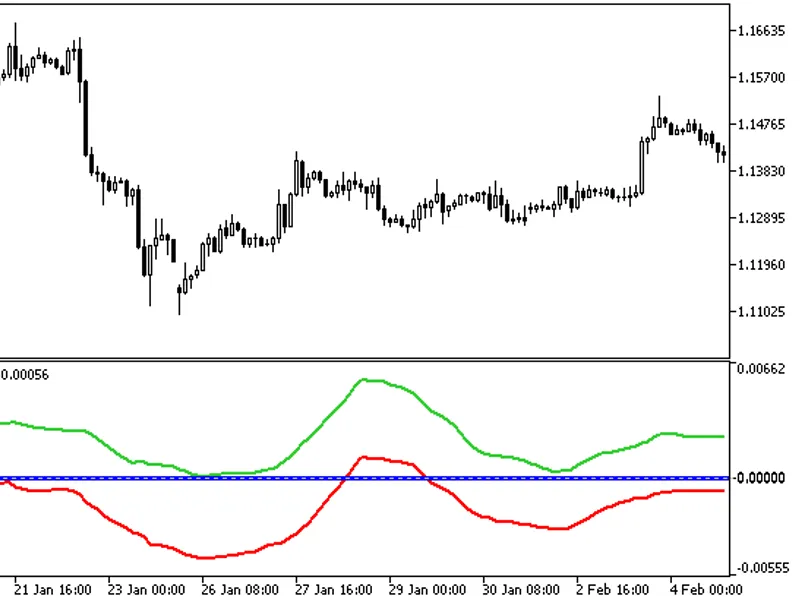
Micro Pivots
This tool for MetaTrader 5 is specifically engineered to streamline your trading operations. This technical indicator acts as a specialized analysis tool designed to visualize market data. It helps traders identify emerging trends, momentum shifts, and key support or resistance levels by plotting statistical calculations directly onto price charts.
How to Setup and Use Micro Pivots
1. Installation: Place your file in the MQL/Indicators folder via "Open Data Folder" and restart your terminal.
2. Loading: Find the indicator in the Navigator, drag it onto your chart, and configure the input parameters in the popup window.
3. Customization: Press Ctrl+I to open the indicator list, select your tool, and click "Properties" to change colors, levels, or visual styles.
4. Updating: Replace the old file in the Indicators folder with the new version and restart the platform to apply changes.
Frequently Asked Questions
Q: Why is my indicator not showing? A: Verify the file is in the MQL/Indicators folder, or try right-clicking the "Indicators" tree in the Navigator and clicking "Refresh."
Q: Do custom indicators slow down the platform? A: Too many complex indicators can impact performance; remove unused ones via the "Indicator List" (Ctrl+I).
Q: Can I use MT4 indicators on MT5? A: No, MQL4 and MQL5 are distinct languages; ensure the indicator is compiled specifically for your platform version.
Description & Settings
Indicator Micro Pivots displays the selected Fibonacci levels between two moving averages.
It has thirty-two adjustable parameters:
First MA period
- first moving average calculation period
First MA method
- first moving average calculation method
First MA applied price
- first moving average calculation price
Second MA period
- second moving average calculation period
Second MA method
- second moving average calculation method
Second MA applied price
- second moving average calculation price
Show Fibo-level 1
- show Fibonacci level 1
Fibo-level 1 value
- value of Fibonacci level 1
Show Fibo-level 2
- show Fibonacci level 2
Fibo-level 2 value
- value of Fibonacci level 2
Show Fibo-level 3
- show Fibonacci level 3
Fibo-level 3 value
- value of Fibonacci level 3
Show Fibo-level 4
- show Fibonacci level 4
Fibo-level 4 value
- value of Fibonacci level 4
Show Fibo-level 5
- show Fibonacci level 5
Fibo-level 5 value
- value of Fibonacci level 5
Show Fibo-level 6
- show Fibonacci level 6
Fibo-level 6 value
- value of Fibonacci level 6
Show Fibo-level 7
- show Fibonacci level 7
Fibo-level 7 value
- value of Fibonacci level 7
Show Fibo-level 8
- show Fibonacci level 8
Fibo-level 8 value
- value of Fibonacci level 8
Show Fibo-level 9
- show Fibonacci level 9
Fibo-level 9 value
- value of Fibonacci level 9
Show Fibo-level 10
- show Fibonacci level 10
Fibo-level 10 value
- value of Fibonacci level 10
Show Fibo-level 11
- show Fibonacci level 11
Fibo-level 11 value
- value of Fibonacci level 11
Show Fibo-level 12
- show Fibonacci level 12
Fibo-level 12 value
- value of Fibonacci level 12
Show Fibo-level 13
- show Fibonacci level 13
Fibo-level 13 value
- value of Fibonacci level 13
Types of moving averages that can be used as the calculation method:
Simple
-
Exponential
-
Smoothed
-
Linear-Weighted
-
Wilder Exponential
-
Sine-Weighted
-
Triangular
-
Least Square
-
Hull MA by Alan Hull
-
Zero-Lag Exponential
-
Instantaneous Trendline by J.Ehlers
-
Moving Median
-
Geometric Mean
-
Regularized EMA by Chris Satchwell
-
Integral of Linear Regression Slope
-
Combination of LSMA and ILRS
- moving average - combination of and methods
Triangular MA generalized by J.Ehlers
-
Volume-Weighted
-