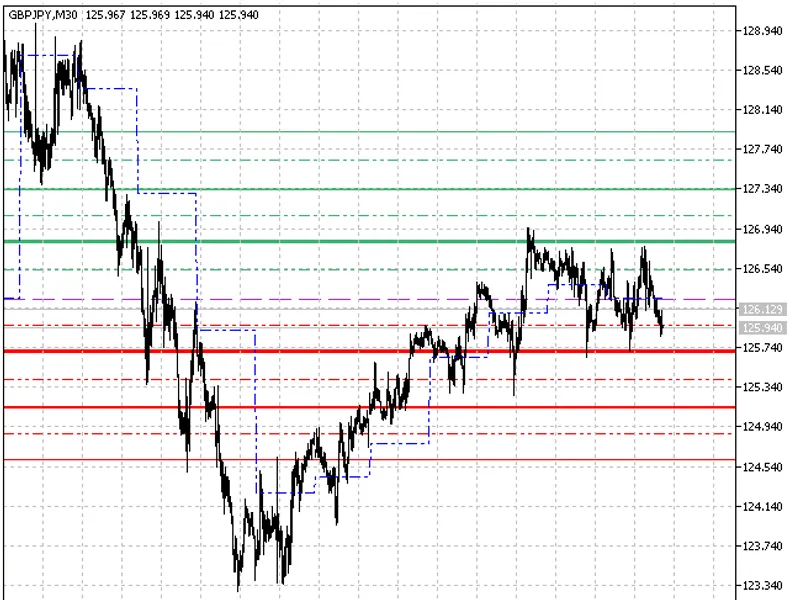
Daily Pivot Points
This professional-grade solution for MetaTrader 5 helps traders achieve greater efficiency in their daily workflow. This technical indicator acts as a specialized analysis tool designed to visualize market data. It helps traders identify emerging trends, momentum shifts, and key support or resistance levels by plotting statistical calculations directly onto price charts.
How to Setup and Use Daily Pivot Points
1. Installation: Place your file in the MQL/Indicators folder via "Open Data Folder" and restart your terminal.
2. Loading: Find the indicator in the Navigator, drag it onto your chart, and configure the input parameters in the popup window.
3. Customization: Press Ctrl+I to open the indicator list, select your tool, and click "Properties" to change colors, levels, or visual styles.
4. Updating: Replace the old file in the Indicators folder with the new version and restart the platform to apply changes.
Frequently Asked Questions
Q: Why is my indicator not showing? A: Verify the file is in the MQL/Indicators folder, or try right-clicking the "Indicators" tree in the Navigator and clicking "Refresh."
Q: Do custom indicators slow down the platform? A: Too many complex indicators can impact performance; remove unused ones via the "Indicator List" (Ctrl+I).
Q: Can I use MT4 indicators on MT5? A: No, MQL4 and MQL5 are distinct languages; ensure the indicator is compiled specifically for your platform version.
Description & Settings
The DailyPivot Points indicator helps to compose a picture of market future movements, in distinct from the other tools that hang behind the market.
The information that became availble in the course of the previous day is used to calculate the check points of the minor trend of the current day.
Pivot Point (PP) is the equilibrium point - a level the price is attracted to throughout the day. Having three values for the previous day: maximum, minimum and close price, 13 levels for smaller timeframes are calculated: equilibrium point, 6 resistance levels and 6 support levels. This levels are called check points.
The check points provide the possibilty of easy determining the direction of the minor trend. Three values are most important - levels of equilibrium point, Resistance1 (RES1.0) and Support1 (SUP1.0). The pauses in the movement, or even a roll-back, are frequently seen during the moving of the price betweeen these values.
In such a way, the DailyPivot Points indicator:
forecasts the range of prices variation;
demonstrates the possible price stops;
demonstrates the possible points of changing the direction of price movement.
If the market on the current day opens above the equilibrium point, then it is the signal for opening long positions. If the market opens below the equilibrium point, then the current day is favourable for opening short positions.
The method of check points consists in the monitoring the possibility of turning and breakthrough when the price collides with the resistance level RES1.0 or with the support level SUP1.0. By the time when the price reaches the RES2.0, RES3.0 or SUP2.0, SUP3.0 levels, the market appears to be overbought or oversold as a rule, so these levels are mostly used as the exit levels.
This indicator was first implemented in MQL4 and published in 23.12.2005.
Calculation:
The calculation on the basis of HIGH, LOW and CLOSE values of the previous day generates the new values Pivot Point (PP), Resistance1 (RES1.0), Resistance2 (RES2.0), Resistance3(RES3.0), Support1 (SUP1.0), Support2 (SUP2.0) and Support3 (SUP3.0), and also the intermidiate values Resistance0.5(RES0.5), Resistance1.5 (RES1.5), Resistance2.5 (RES2.5), Support0.5(SUP0.5), Support1.5 (SUP1.5) and Support2.5 (SUP2.5).
In such a manner, the mapping to the future of maximums and minimums of the previous days is involved.
where:
HIGH - the maximum price of the previous day;
LOW - the minimum price of the previous day;
CLOSE - the close price of the previous day;
PP - the equilibrium point (typical price of the previous day);
RES0.5, RES1.0, RES1.5, RES2.0, RES2.5, RES3.0 - the check points (resistance levels);
SUP0.5, SUP1.0, SUP1.5, SUP2.0, SUP2.5, SUP3.0 - the check points (support levels).