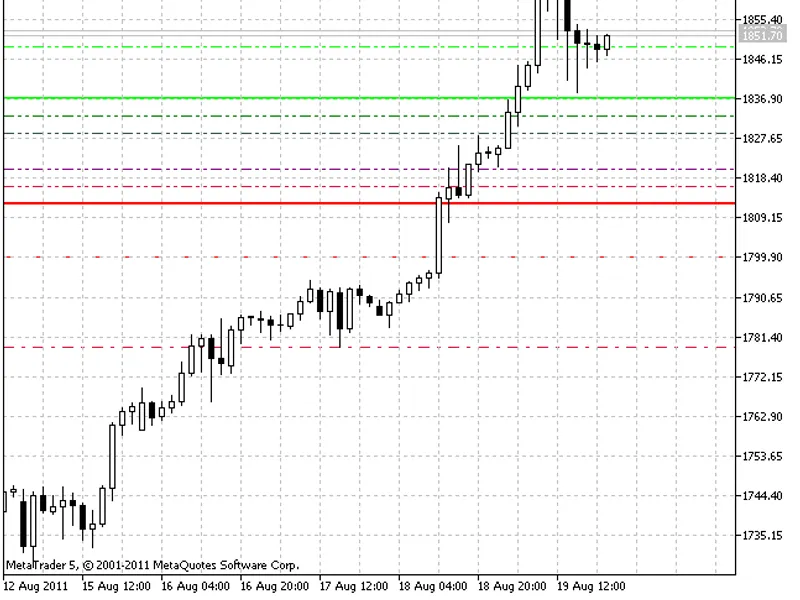
Camarilla Equation
This is a powerful addition to your MetaTrader 5 toolkit designed to optimize market analysis and performance. This technical indicator acts as a specialized analysis tool designed to visualize market data. It helps traders identify emerging trends, momentum shifts, and key support or resistance levels by plotting statistical calculations directly onto price charts.
How to Setup and Use Camarilla Equation
1. Installation: Place your file in the MQL/Indicators folder via "Open Data Folder" and restart your terminal.
2. Loading: Find the indicator in the Navigator, drag it onto your chart, and configure the input parameters in the popup window.
3. Customization: Press Ctrl+I to open the indicator list, select your tool, and click "Properties" to change colors, levels, or visual styles.
4. Updating: Replace the old file in the Indicators folder with the new version and restart the platform to apply changes.
Frequently Asked Questions
Q: Why is my indicator not showing? A: Verify the file is in the MQL/Indicators folder, or try right-clicking the "Indicators" tree in the Navigator and clicking "Refresh."
Q: Do custom indicators slow down the platform? A: Too many complex indicators can impact performance; remove unused ones via the "Indicator List" (Ctrl+I).
Q: Can I use MT4 indicators on MT5? A: No, MQL4 and MQL5 are distinct languages; ensure the indicator is compiled specifically for your platform version.
Description & Settings
Camarilla Equation system was implemented by Nick Stott at the end of 1980s.
Camarilla Equation consists of 8 or 10 levels (in later modifications) calculated by using Open, Close, High and Low prices of a previous trading session and a set of instructions on the application of these levels in trading.
The levels are divided in two groups. The first one is built downwards from the yesterday's Close price, indicated by L symbol (for "Low") and numbered from 1 to 5. Similarly, the second group of levels is built upwards from the yesterday's Close price, indicated by H symbol (for "High") and also numbered from 1 to 5.
It should be noted that levels 1 and 2 have comparatively small value and are often not considered. As for L5 and H5 levels, they should always be considered, though they are ignored in some sources.
Camarilla Equation levels are calculated the following way: